Diffusion Finished
Studying how parties' policy positions diffuse across nations
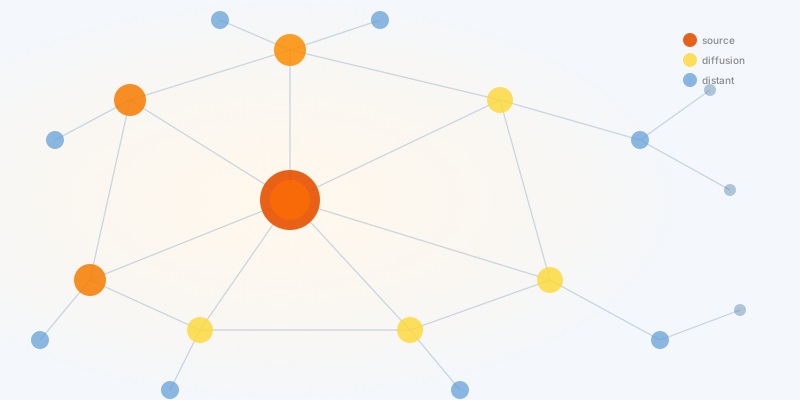
This project examines how political parties — especially across national and European levels — engage in policy diffusion and issue transfer, and the role of transnational alliances and party networks in shaping domestic and EU-level agendas. The policy diffusion literature largely treats states as unitary actors, leaving the role of parties and transnational alliances in cross-national issue transfer comparatively underexplored.
Approach
- Conceptual synthesis: A pluralistic framework of party policy diffusion in the EU multilevel space, distinguishing actors, objects, and mechanisms.
- Spatial econometric analysis: Spatial regression models on Comparative Manifesto Project data from 26 Western European democracies (1977–2016).
- Dyadic panel analysis: Monthly dyadic dataset of written parliamentary questions by Danish MPs and MEPs (1999–2009).
Key Findings
- Transnational alliance effects: Parties sharing an EP party group exhibit two-to-three times stronger short- and long-term ideological imitation than parties outside the group.
- Multilevel policy issue transfer: Policy issues transfer regularly between national and European venues, predominantly within parties sharing the same brand.
- Directional agenda-setting: Transfers are more likely from the domestic to the EU level, especially where the EU holds substantial legislative authority.
Publications
- “Do Voters Want Domestic Politicians to Scrutinize the European Union?” Political Science Research & Methods (2023). With Roman Senninger.
- “How Transnational Party Alliances Influence National Parties' Policies.” Political Science Research & Methods (2022). With Roman Senninger and Lawrence Ezrow.
- “Party policy diffusion in the European multilevel space: what it is, how it works, and why it matters.” Journal of Elections, Public Opinion and Parties (2020). With Fabio Wolkenstein and Roman Senninger.
- “Working in unison: Political parties and policy issue transfer in the multilevel space.” European Union Politics (2018). With Roman Senninger.