Messaging Styles Finished
Studying how political elites craft messages and how voters respond
This project examines elite messaging strategies and manifesto analysis, audit experiments on political responsiveness, and studies of linguistic complexity and framing effects in campaign messages.
While much work examines what political elites say and how voters interpret policy content, less is known about the interplay between elite communication style — complexity, framing, source cues — and elite responsiveness to constituent signals.
Approach
- Textual analysis: Developed and validated the LIX readability index on 175 party manifestos from Austria and Germany (1945–2013).
- Survey experiments: Preregistered two-wave vignette and conjoint experiments in Germany (N = 5,800).
- Audit experiments: Confederate-based field experiments measuring MPs' responsiveness to constituent messages of varying style.
Key Findings
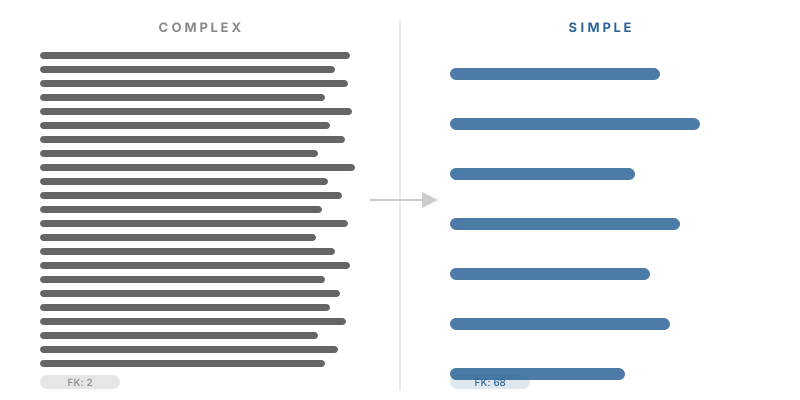
- Populist simplicity: Populist parties systematically use less complex language than mainstream competitors.
- Enhanced placement accuracy: Voters locate parties more accurately on the left–right spectrum when campaign messages are simpler.
- Comprehension boost: Simple messages significantly improve citizens' understanding of policy positions.
- Heuristic effects: Simple framing leads citizens to perceive speakers as more "of the people."
- Elite responsiveness: British MPs respond to constituent policy queries in much the same way regardless of whether constituents agree with their party — there is little evidence that they tailor response rates or emphasize themselves over their party.
Publications
- “Can Simple Language Affect Voters' Political Knowledge and Their Beliefs About Politicians?” Journal of Politics (2026). With Roman Senninger.
- “When Legislators Do Not Differentiate: A Field Experiment on British MPs' Responses to Constituent Policy Queries.” British Journal of Political Science (2026). With Vanessa Cheng-Matsuno, Gidon Cohen, and 6 others.
- “Advantages, Challenges and Limitations of Audit Experiments with Constituents.” Political Studies Review (2022). With Gidon Cohen, Sarah Cohen, and 5 others.
- “Simple politics for the people? Complexity in campaign messages and political knowledge.” European Journal of Political Research (2018). With Roman Senninger.
Funding
- British Academy/Leverhulme Trust Small Research Grant with Florian Foos & Kyriaki Nanou: €11,000 (2017–2019)